If you’ve ever had a mold slider seize up in the middle of a high-volume production run, you know the nightmare. You’re looking at a pulled slide, damaged guide rails, and a press that’s sitting idle for hours, if not days. In injection molding, the sliding mechanics—whether it’s a standard side-action slider, an angled lifter (斜顶), or a complex core pull—are the most frequent points of mechanical failure.
The traditional fix was always “more grease.” But in modern molding, especially for medical, food-packaging, or high-aesthetic automotive parts, grease is often the enemy. This is where graphite bronze bushings and wear plates have become the industry standard. They aren’t just a “nice to have” upgrade; they are a strategic necessity for reducing cycle times and eliminating part contamination.
The Mechanical Friction Problem in Mold Sliders
Injection mold sliders operate under brutal conditions. You have high clamping forces, rapid reciprocating motion, and—most importantly—extreme temperature fluctuations. When the mold heats up to operating temperature, the steel components expand. If your slider tolerances are tight, that expansion can turn a smooth sliding fit into a high-friction nightmare.
Standard steel-on-steel or grease-lubricated bronze components suffer from several fatal flaws:
- The “Dry Start” Effect: After a mold sits overnight, the oil film drains away. The first few cycles happen metal-to-metal, causing micro-galling that eventually leads to catastrophic seizure.
- Viscosity Breakdown: As mold temperatures rise (especially in engineering plastics like PEEK or PPS), standard grease thins out and migrates away from the friction zone.
- Debris Trapping: Sticky grease acts like a magnet for airborne dust and metallic fines, creating an abrasive paste that grinds down your slider’s accuracy.
What is a Graphite Bronze Bushing in the Context of Molding?
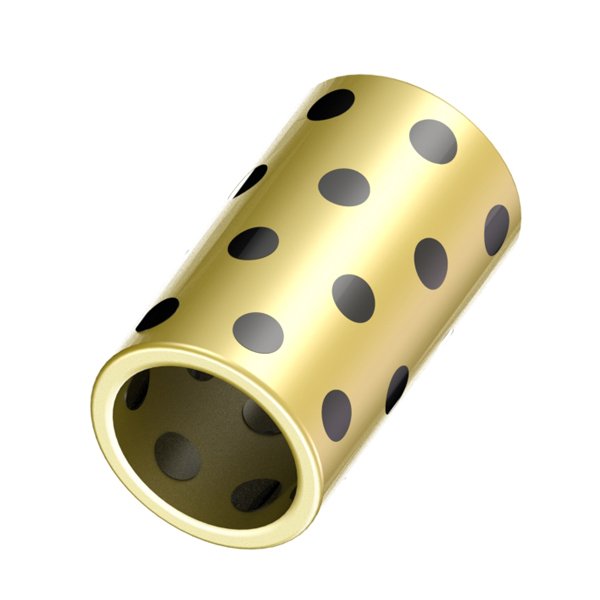
A graphite bronze bushing (or wear plate) used in sliders is a “solid lubricant” delivery system. It typically uses a high-tensile bronze base—usually C86300 (Manganese Bronze)—with plugs of specialized graphite embedded into the wear surface.
During the sliding action, the graphite plugs release a microscopic layer of dry lubricant onto the mating surface (the slide core or the guide rail). This creates a permanent, low-friction boundary layer that doesn’t depend on oil pumps or manual greasing. In the molding world, we call this “self-lubricating,” but technically, it’s a controlled-release friction management system.
Key Selection Factors for Slider Applications
When you’re specifying components for a new mold build or retrofitting a problematic slider, you can’t just pick a random part from a catalog. You need to look at three specific engineering metrics.
1. Compressive Strength (Static vs. Dynamic)
In a slider, the “clamping pressure” often creates massive static loads before the slide even moves. You need a material that won’t deform under these pressures.
- Manganese Bronze (C86300): This is the workhorse. It has a hardness of HB 210+ and can handle high-pressure stamping and heavy molding loads.
- Aluminum Bronze (C95400): Better if you’re dealing with corrosive cooling vapors or high-humidity environments, though slightly less “tough” than manganese bronze in pure compression.
2. Thermal Expansion Match
If you’re running a hot mold (150°C+), your bronze bushing will expand faster than the steel slide. If you don’t account for this in your initial clearance, the bushing will “choke” the slide.
- Engineer’s Tip: For sliders, I always recommend a slightly “looser” fit than you’d use on a standard machine tool. A clearance of 0.02mm to 0.05mm is often necessary to ensure smooth action once the mold reaches thermal equilibrium.
3. Lubricant Plug Coverage
For sliders and angled lifters, the graphite plugs should be arranged in a “staggered” pattern. This ensures that every millimeter of the mating steel surface is covered by a lubricant track. If the plugs are aligned in a straight line, you’ll get “dry strips” on your slide, leading to uneven wear and eventual “snagging.”
Real-World Scenarios: Where Graphite Bronze Wins
The Contamination-Free Zone (Medical & Food)
If you are molding transparent PC (Polycarbonate) or medical-grade PP, a single drop of black grease from a slider guide can scrap thousands of dollars worth of parts. Graphite bronze allows you to run completely dry. Since the graphite is a solid, it stays in the bushing and doesn’t “mist” onto the molded parts.
Angled Lifters and Core Pulls
Lifters are notorious for seizing because they often sit at awkward angles where gravity works against traditional liquid lubricants. Because a graphite bronze bushing provides lubrication in all orientations, it’s the ideal solution for lifters that have to travel several inches per cycle.
High-Speed Packaging
When you’re running 3-second cycles, there is no time for a lubrication system to “recover.” The heat build-up is localized and intense. The high thermal conductivity of the bronze base helps pull heat away from the friction face, while the graphite ensures the friction coefficient stays below 0.15.
Common Problems and Installation Mistakes
I’ve seen plenty of “failed” graphite bushings that were actually victims of poor engineering, not bad material.
- The “Hammer Fit”: Never hammer a graphite bushing into the mold base. The impact can crack the graphite plugs or deform the bronze shell. Use a hydraulic press or a chilled-fit method.
- Soft Mating Surfaces: This is the #1 killer. If you run a graphite bronze bushing against soft P20 steel, the graphite won’t work correctly. You need a mating surface—like your slider core or guide rail—hardened to HRC 55-60. The graphite needs a hard, ground surface to “burnish” onto.
- Rough Finishes: If your slide rails are roughly milled, they will act like a file and shred the bronze. Aim for a surface finish of Ra 0.8 or better.
Comparison: Traditional Lubrication vs. Graphite Bronze
| Feature | Traditional Grease/Oil | Graphite Bronze (Self-Lube) |
| Maintenance | High (Requires frequent intervals) | Zero (Set and forget) |
| Cleanliness | Poor (Risk of part contamination) | Excellent (Dry operation) |
| High Temp Performance | Grease thins/burns | Stable up to 300°C+ |
| Initial Cost | Low | Moderate |
| Total Cost of Ownership | High (Downtime + Labor) | Low (Extended tool life) |
Why Mold Shops are Replacing Old Steel Wear Plates
The shift toward graphite-embedded components is driven by the push for “Lights Out” manufacturing. You cannot run an automated cell if someone has to stop the press every 4 hours to grease a slider.
Furthermore, graphite bronze bushings for injection mold sliders provide a safety net. If a water line leaks or a cooling channel fails, the bronze/graphite combo can survive a temporary “overheat” condition that would weld a steel-on-steel slide together instantly.
Summary
In the world of precision molding, the slider is often the “weakest link.” Using graphite bronze components—whether they are flanged bushings for core pins or wear plates for large side-actions—is the most effective way to stabilize your process.
To get the most out of them:
- Ensure Mating Surfaces are Hardened: HRC 58+ is the target.
- Account for Thermal Expansion: Don’t spec a “press fit” that turns into a “seize fit” at 200°C.
- Go Dry: If your part aesthetics matter, ditch the grease entirely.
By focusing on these mechanical fundamentals, you’ll spend less time pulling molds for repair and more time shipping parts. If you’re currently dealing with a “sticky” slider, the first thing I’d check isn’t the grease—it’s the material of your wear components. Moving to a self-lubricating bronze setup is usually the last fix you’ll ever need for that tool.