In high-speed stamping or heavy-duty forging, the guide system is the heartbeat of the tool. If your stamping die bushings fail, you aren’t just looking at a $50 part replacement; you’re looking at sheared punches, ruined die plates, and hours of unplanned downtime. For years, the industry standard was traditional steel-on-steel or bronze-plated guide systems that required constant manual lubrication. But in a modern production environment—where press speeds exceed 300 strokes per minute or where vertical loads reach several hundred tons—manual greasing is a liability.
This is why many mold shops and Tier 1 automotive suppliers have moved toward graphite bronze bushings (solid lubricant embedded bearings). They solve the fundamental problem of the “dry start” and the inevitable failure of traditional guide system wear.
The Core Concept: Why Solid Lubricant?
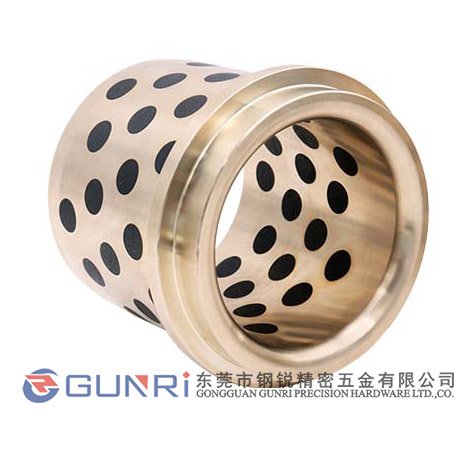
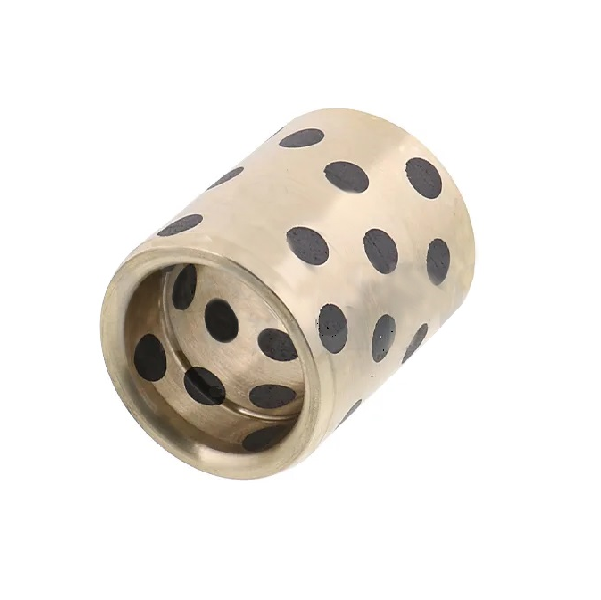
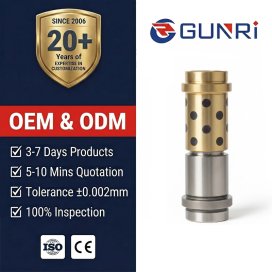
A graphite bronze bushing consists of a high-strength bronze alloy base—typically C86300 Manganese Bronze—with specifically patterned holes plugged with solid lubricant (usually a graphite-based composite).
The physics are simple: as the guide pillar (leader pin) moves within the bushing, a microscopic layer of graphite is transferred to the shaft. This creates a low-friction “film” that prevents metal-to-metal contact. Unlike liquid oil, this film doesn’t squeeze out under high pressure, and it doesn’t dry up during a weekend shift change.
Stamping Die Guide Systems: Standard Bronze vs. Graphite Bronze
In a standard guide system, you usually see two setups:
- Ball Bearing Guides: Great for extremely high speeds but terrible for high lateral loads. They have a limited contact area.
- Plain Sliding Guides: Traditional bronze-plated steel. These require a constant oil mist or manual grease.
When we talk about stamping die bushings, the move to graphite-embedded versions is driven by the need for a higher PV (Pressure-Velocity) limit.
Load Capacity Comparison
Traditional bronze-plated bushings often struggle when lateral forces increase—common in unbalanced stamping dies or progressive dies with heavy side-loading. Manganese bronze bases can handle static loads up to 100 N/mm². Under dynamic conditions, the graphite plugs ensure that even if the lubrication pump fails, the bronze won’t seize onto the guide pillar instantly.
Key Selection Factors for the Shop Floor
Choosing the right bushing isn’t just about matching the ID and OD. You have to look at the environment.
1. Stroke Frequency and Speed
In high-speed stamping, heat is the enemy. While graphite bronze is excellent for heat dissipation, if you’re running at exceptionally high frequencies (500+ SPM), the thermal expansion of the bronze can close the clearance between the guide pillar and the bushing.
- Advice: For high-speed applications, specify a larger initial clearance (e6 or f7 fits) to account for thermal “growth.”
2. The Load Environment
Are you doing light-gauge electronic connectors or heavy-duty automotive frame stamping?
- Heavy Loads: Stick with C86300 (Manganese Bronze) with graphite plugs. It has the compressive strength to prevent the bushing from “egging out” or deforming under side-thrust.
- Corrosive/Washdown: If the die is being stored in high-humidity or used in applications with coolant, consider Aluminum Bronze (C95400) bases, which offer better corrosion resistance than Manganese Bronze.
3. Lubrication Realities: The “Maintenance-Free” Myth
“Self-lubricating” does not always mean you cannot use oil. In many stamping scenarios, a light drip of oil helps flush out metal slivers and debris. However, the graphite bronze bushing is designed for the “unable to lubricate” scenario. If your die is located in a part of the press where the automated lube lines can’t reach, or if the environment is too hot for standard grease, graphite is your only real choice.
Why Die Shops are Replacing Traditional Guides
The primary driver for switching to graphite-embedded systems is the reduction of MTTR (Mean Time To Repair).
In a traditional setup, guide system wear is the leading cause of “slug pulling” and poor part quality. Once the guide system loses its tight tolerance, the punch and die clearance becomes uneven. You’ll see burrs on one side of your part and a clean cut on the other.
- The Graphite Advantage: Because the graphite film is self-renewing, the wear rate is remarkably linear and predictable. You don’t get the sudden “galling” or seizing that happens when a manual lubrication line gets pinched.
- Consistency: For progressive dies, maintaining the center-line accuracy over millions of strokes is critical. Graphite bronze maintains its ID dimensions longer than traditional oil-groove bronze under high-impact conditions.
Real Application Scenarios
High-Speed Electronic Terminals
In these dies, the strokes are short but extremely frequent. A standard bronze bushing would require an oil bath. Using graphite bronze allows for a cleaner work environment—essential if the parts are being plated or cleaned immediately after stamping.
Automotive Structural Parts
Here, we deal with heavy plates and high lateral forces during the forming stage. We often use flanged graphite bronze bushings to handle both the radial load of the guide and the axial thrust of the die set coming together.
Foundry and Hot-Stamping
Temperatures can exceed 200°C. Standard oils carbonize and turn into “glue” at these temps. Graphite is stable up to 400°C+, making it the only viable lubricant for hot-forming guide systems.
Common Mistakes and Failures
Even the best stamping die bushings will fail if installed incorrectly. Here are the three most common field failures I’ve seen:
- Improper Press Fitting: If you hammer a bushing into a hole that is too small, you will deform the ID. This “close-in” effect can reduce the clearance to zero, leading to immediate seizing on the first stroke. Always use a hydraulic press and verify the housing bore tolerance (usually H7).
- Using Soft Guide Pillars: Graphite needs a hard surface to “burnish” onto. If your leader pins are just soft-turned steel, the graphite will actually wear the pin down rather than lubricating it. You need a surface hardness of at least HRC 58-62.
- Contamination: While these are “self-lubricating,” they aren’t “self-cleaning.” If metal shavings or grinding dust get into the bushing, they get embedded into the soft bronze and turn the bushing into a lap, destroying the expensive guide pillar.
Comparison: Graphite Bronze vs. PTFE/POM Composites
| Feature | Graphite Bronze | PTFE-Lined (DU/DX) |
| Max Load | Very High ($100 \text{ N/mm}^2$) | Moderate ($30 \text{ N/mm}^2$) |
| Durability | High (Solid Metal) | Low (Thin Polymer Layer) |
| Repairability | Can be re-reamed/bored | Replacement Only |
| Speed | Moderate to High | Low to Moderate |
| Impact Resistance | Excellent | Poor (Liner may delaminate) |
In a stamping die, the PTFE-lined “dry” bushings are usually too fragile. One bad hit or a slightly misaligned die can peel the PTFE layer right off the steel backing. For industrial guide systems, the solid bronze body of the graphite-plugged bushing is much more forgiving of real-world abuse.
Summary
The switch to graphite bronze bushings in stamping die guide systems is a move toward reliability. By eliminating the reliance on consistent manual lubrication, you remove the biggest variable in tool wear.
When selecting your components, prioritize the base alloy’s hardness and ensure your guide pillars are sufficiently hardened. If you are struggling with guide system wear or excessive downtime for greasing, upgrading the guide bush is the most cost-effective change you can make to your die maintenance program.
For engineers currently designing new tools: look at your PV values and operating temperatures. If you’re near the limit of standard bronze, go with graphite. It’s better to have the overhead and not need it than to have a seized press on a Monday morning.
Technical Specs for Reference:
- Base Material: Manganese Bronze (HB210-250)
- Lubricant: Solid Graphite + Additives
- Max Temp: 300°C (Standard), 400°C+ (Custom)
- Coefficient of Friction: 0.03 – 0.20 (depending on load/speed)