In the world of thermal processing—whether it’s industrial baking, heat treatment, or glass manufacturing—the pivot points and conveyor rollers inside the furnace are where engineering logic often breaks down. If you’ve ever designed or maintained furnace equipment, you know that standard lubricants have a “ceiling.” Once you cross the 200°C threshold, traditional greases don’t just thin out; they carbonize, turning into a sticky, abrasive sludge that seizes bearings and snaps drive chains.
Using oilless bushings (specifically graphite-embedded solid lubricant bearings) isn’t just an alternative for these environments; it’s a survival requirement. When liquid oil is physically impossible to maintain, you need a material that uses the heat to its advantage rather than being destroyed by it.
The Problem: Why Liquid Lubricants Fail in Furnaces
Most industrial greases are rated for a maximum “drop point” around 180°C to 250°C. However, the base oil typically begins to oxidize and evaporate much lower than that. In a furnace environment running at 300°C or 500°C, the liquid component of the grease vanishes, leaving behind the thickener and additives. This residue hardens into a “coke” that acts more like a mechanical lock than a lubricant.
Furthermore, outgassing is a major concern. In cleanroom furnaces or food-grade baking ovens, evaporating oil can contaminate the product. This creates a Catch-22: you need lubrication to prevent the rollers from seizing, but you can’t risk the oil vapors ruining your batch. Self-lubricating bronze bearings solve this by replacing the liquid phase with a solid-state lubricant that remains stable at extreme temperatures.
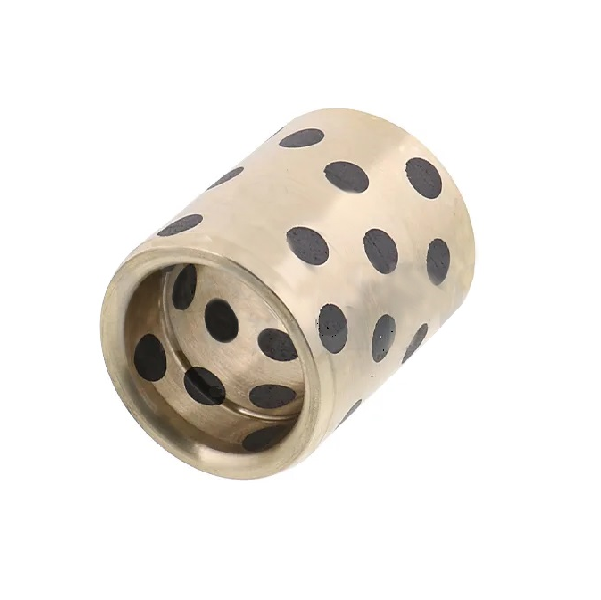
Understanding Graphite-Plugged Bronze Technology
For high-temperature furnace equipment, we typically move away from standard tin-bronze and toward a specialized C86300 Manganese Bronze or Nickel-Aluminum Bronze base. These alloys retain their mechanical strength and creep resistance even when the ambient temperature approaches 400°C.
The lubrication comes from high-purity graphite plugs pressed into the bearing wall in a staggered pattern. Unlike oil, graphite’s lubricity actually improves in certain high-heat environments. It creates a “transfer film” on the shaft, ensuring that the friction coefficient remains low (typically 0.10 to 0.20) even when the furnace is at peak soak.
Temperature Ratings and Limits
- Standard Oilless Bushings: Rated up to 300°C.
- High-Temp Graphite Grades: With specialized inorganic binders, these can push toward 500°C or 600°C.
- The Shaft Factor: At these temperatures, the bushing isn’t the only thing expanding; your shaft is too. This makes clearance calculation the most critical part of the design.
Key Selection Factors for Furnace Applications
If you are spec’ing a bushing for a kiln car, a damper control, or a furnace conveyor, you have to look at the “Clearance vs. Temperature” curve.
1. Thermal Expansion and “Close-In”
Bronze expands significantly faster than steel. If you install a bushing with a standard “room temperature” fit, it will expand inward as the furnace heats up, “choking” the shaft.
- Engineering Practice: We typically specify a “loose” initial fit—sometimes as much as 0.1mm to 0.2mm of clearance on a 50mm shaft—to allow for thermal expansion. If the shaft feels “sloppy” at room temperature, it’s probably designed correctly for 400°C.
2. Base Metal Strength at Temp
Not all bronze is created equal. At 350°C, a standard leaded bronze loses nearly 50% of its yield strength. You need a material like Manganese Bronze (C86300) which maintains high hardness (HB 210+) at elevated temperatures. This prevents the bushing from “egging out” under the weight of the furnace load.
3. Graphite Plug Quality
In low-end bushings, the graphite plugs are just carbon powder and wax. In a furnace, the wax melts, and the graphite falls out. For high-temp use, the plugs must be a solid-pressed composite that uses high-temperature binders. This ensures the lubricant stays in the hole until it is “pulled” out by the friction of the shaft.
Real Application Scenarios
1. Heat Treatment Kiln Conveyors
Kiln cars carry tons of steel through heating cycles. Traditional ball bearings fail here because the heat softens the races and the grease vanishes. Graphite bronze bushings installed in the wheels or the pivot linkages allow the car to move smoothly through the hot zone without any manual maintenance.
2. Glass Manufacturing
Glass lehrs operate at constant high heat. Any oil mist in the air can cause defects in the glass surface. Using self-lubricating bushings in the roller supports keeps the line moving while ensuring the environment remains “oil-free.”
3. Damper and Valve Actuators
Furnace exhaust dampers often sit idle for long periods in a hot stream of gas. When they finally need to move, they must move instantly. Liquid grease would have long ago dried into a crust. The graphite film, however, remains active forever, ensuring the damper doesn’t seize when an emergency shutdown is triggered.
Common Mistakes and Failure Modes
Even the best oilless bushings will fail if you ignore the system’s physics.
- Using the Wrong Shaft Hardness: In a furnace, the shaft will also undergo thermal cycling. If you use a soft stainless steel shaft (like 304), it may gall. I recommend at least a 400 series stainless or a hardened/chrome-plated steel shaft (HRC 50+). The graphite needs a hard, stable surface to burnish onto.
- Ignoring the Housing Material: If your housing is aluminum but your bushing is bronze and your shaft is steel, you have three different expansion rates. This is a recipe for a bushing that either falls out of the housing or seizes the shaft. Always try to match the housing and bushing expansion as closely as possible, or use mechanical locking (flanges/screws).
- Contamination from Ash: In wood-fired or coal-fired furnaces, fly ash can enter the joint. While graphite is a solid, enough abrasive ash will eventually wear the bronze. Use labyrinth seals or shielded housing designs to keep the large particulates out.
Comparison: Graphite Bronze vs. PTFE vs. Ceramic
| Feature | Graphite Bronze | PTFE (Teflon) | Ceramic (Zirconia) |
| Max Temp | 400°C – 600°C | 260°C (Max) | 800°C+ |
| Load Capacity | High ($100 \text{ N/mm}^2$) | Low ($10 \text{ N/mm}^2$) | Moderate to High |
| Impact Resistance | Excellent | Poor (Soft) | Poor (Brittle) |
| Machinability | Easy | Very Easy | Impossible (Grinding only) |
| Cost | Moderate | Low | Very High |
For the majority of industrial furnaces, graphite bronze is the “sweet spot.” PTFE melts too early, and ceramic is too brittle and expensive for large-scale mechanical pivots.
Summary
Designing for high temperature furnace equipment requires a shift in mindset from “how do I lubricate this?” to “how do I make it work without lubrication?” Oilless bushings provide that bridge. By utilizing a high-strength bronze matrix and solid graphite inserts, you eliminate the single most common cause of furnace downtime: grease failure.
If you are planning a furnace build or retrofit:
- Verify your maximum “soak” temperature.
- Calculate your thermal expansion clearances (be generous).
- Specify a hardened mating shaft (HRC 50+).
- Choose a Manganese Bronze base for structural integrity.
In an environment where oil is the enemy, solid lubricants are the only way to ensure your equipment doesn’t become a permanent part of the furnace structure. Getting the material and the clearance right at the CAD stage is the difference between a machine that runs for five years and one that seizes in five days.