If you’ve ever stood next to a 50-ton excavator working a rock face, you know that the boom joints are under absolute torture. We’re talking about massive vertical loads combined with unpredictable lateral forces and constant, heavy shock—all while being blasted by silica dust, mud, and grit. In these field conditions, a standard greased steel bushing is a ticking time bomb. If the operator misses a single lube cycle, the pin starts eating the bushing, and within a week, you have enough “slop” in the bucket to ruin your grading precision.
This is why graphite bronze bushings have shifted from being a “specialty” part to a critical component for heavy equipment reliability. They solve the fundamental failure point of earthmoving machinery: the reliance on perfect maintenance in imperfect environments.
The Reality of Excavator Boom Joint Stress
In a typical excavator linkage, the joint at the base of the boom and the “stick” connection handles the highest torque. Every time the bucket hits a buried boulder, a massive shock load travels through the pin and into the bushing wall.
Traditional steel bushings rely on a thin film of grease to keep the metal surfaces apart. The problem? High-load, low-speed oscillation. At these speeds, you never achieve a hydrodynamic oil film. You are constantly in “boundary lubrication” territory. Add in a little bit of construction dust—which acts like a grinding compound—and your grease becomes a liability rather than a lubricant.
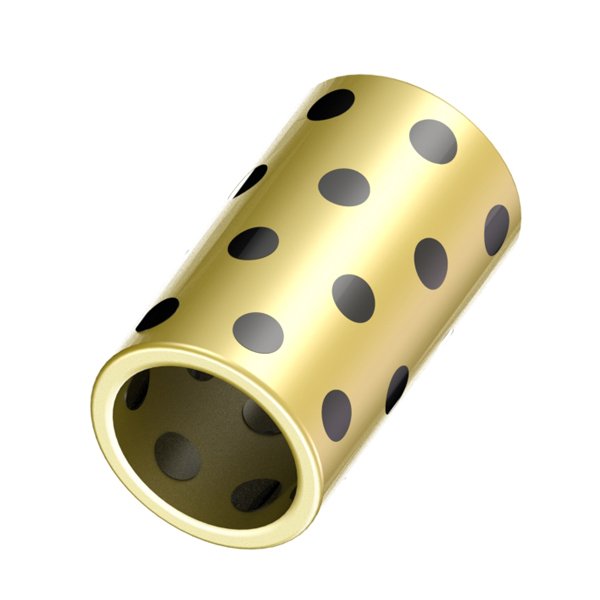
Graphite-embedded bronze (solid lubricant bearings) works differently. The bronze provides the structural backbone to resist deformation, while the graphite plugs provide a dry, solid film that doesn’t wash away or attract grit.
What is a Graphite Bronze Bushing in Heavy Equipment?
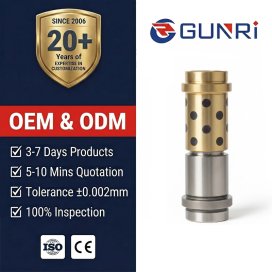
For heavy-duty construction use, these aren’t your standard thin-walled sleeves. We typically use a high-strength yellow brass or manganese bronze base, specifically C86300 (Manganese Bronze).
Material Composition and Strength
- The Base Metal: Manganese bronze is chosen for its exceptional compressive strength, often exceeding $100 \text{ N/mm}^2$ in static load. It’s tough enough to handle the “pounding” of a hydraulic hammer.
- The Solid Lubricant: The holes are plugged with a proprietary blend of graphite and inorganic lubricants. As the boom moves, the pin “pulls” the graphite out of the holes and smears it across the surface.
- Self-Lubricating Mechanism: This creates a friction coefficient between 0.05 and 0.15 without a single drop of external oil.
Key Selection Factors for Boom Joints
When spec’ing graphite bronze bushings for a fleet or a new machine design, you have to look past the dimensions. You need to evaluate the load conditions and the interference fit.
1. Shock Load vs. Static Load
Excavators don’t just “carry” weight; they “impact” it. If the bronze alloy is too soft (like a standard tin bronze), the bushing will “mushroom” or flare at the ends under shock loads. For boom joints, I always insist on a hardness of at least HB 210. This ensures the bushing maintains its circularity even when the operator is being aggressive with the controls.
2. Tolerance and “Close-In”
In heavy equipment, we often use a heavy press fit to ensure the bushing doesn’t spin in the boom ear. For a 100mm pin, you might be looking at an m6 or p6 OD tolerance. You must account for the fact that the internal diameter (ID) will shrink significantly during installation.
- Engineer’s Rule: If you don’t re-measure the ID after pressing, you’re asking for a seized pin. We usually aim for an H7 finished ID fit to allow enough clearance for the graphite film to develop.
3. Dust and Seal Integration
Even though graphite bronze is “self-lubricating,” the environment is still a killer. In a boom joint, you must use high-quality dust seals (O-rings or lip seals) at the ends of the bushing. The goal isn’t to keep grease in, but to keep the large-particle silica out. If sand gets between the graphite and the pin, it will act as an abrasive and wear down even the hardest manganese bronze.
Real Application Scenarios: Where It Saves the Machine
The “Dry” Remote Site
Imagine a machine working in a remote mining site where the auto-lube system has failed. A standard steel bushing would seize or gall the pin within 48 hours. A graphite bronze bushing can continue to operate safely for hundreds of hours under these conditions because the lubrication is “built-in” to the metal matrix.
Underwater and Muddy Conditions
Grease is easily washed away by water or displaced by pressurized mud. Graphite, being a solid, is chemically inert and unaffected by water. This makes these bushings the superior choice for excavators working in marshlands or dredging applications.
Common Problems and Mistakes in the Field
I’ve spent 15 years diagnosing why “reliable” parts fail. With graphite bronze in excavators, the failures usually fall into three categories:
- Using the Wrong Shaft Material: You cannot run a bronze bushing against soft 1018 steel. For boom joints, the pin must be induction-hardened to HRC 55-60 and ground to a smooth finish (Ra 0.4 to 0.8). If the pin is too rough, it will “cheese grate” the bronze.
- Neglecting the Break-In Period: Graphite bushings need a few hundred cycles under moderate load to “transfer” the graphite film to the pin. If you put a brand-new bushing into a machine and immediately go to 100% load in a high-speed application, you can cause localized overheating before the film has formed.
- Mixing Lubricants: Sometimes maintenance crews see a bronze bushing and think, “I’ll add some Moly-grease for extra protection.” While usually harmless, some greases can actually “clog” the graphite plugs and prevent the solid lubricant from transferring, effectively defeating the purpose of the self-lubricating design.
Comparison: Steel vs. Sintered vs. Graphite Bronze
| Feature | Hardened Steel | Sintered (Oil-Impregnated) | Graphite Bronze (C86300) |
| Max Load | Very High | Low to Moderate | High to Very High |
| Lubrication | External Grease Required | Internal Oil | Solid Graphite (Built-in) |
| Maintenance | Hourly/Daily | Periodic | Minimal/None |
| Grit Resistance | Poor (Galls easily) | Moderate | Excellent |
| Impact Resistance | Excellent | Poor (Brittle) | Excellent |
For an excavator boom, hardened steel is the “old way”—strong but high-maintenance. Sintered bearings are too fragile and will crack under the first heavy shock. Graphite bronze is the middle ground that provides the strength of steel with the lubrication reliability of a solid.
Why Maintenance Reduction is the Real ROI
The biggest selling point for a purchasing manager or a shop lead isn’t the “tech”—it’s the Maintenance Reduction.
Every hour a machine spends being greased or having a seized joint repaired is an hour it isn’t moving dirt. In a typical 2,000-hour service interval, the labor and grease costs for a standard joint can exceed the cost of the bushing itself. When you factor in the extended life of the expensive pins (which are protected by the graphite film), the Total Cost of Ownership (TCO) of a graphite bronze system is significantly lower.
Summary
If you are dealing with high-load, high-impact excavator boom joints, switching to graphite bronze bushings is the most effective way to harden your equipment against field neglect.
- For the Engineer: Spec C86300 with a staggered plug pattern and ensure the mating pin is HRC 55+.
- For the Buyer: Look at the long-term saving in downtime and pin wear, not just the initial price tag.
- For the Operator: Ensure your seals are intact. As long as the grit is kept out, the graphite will do the rest of the work.
In the mud and the dirt, you want a joint that doesn’t rely on a human being with a grease gun to stay alive. Graphite bronze provides that insurance policy.