In a high-volume progressive die, the guide system is the single point of failure that determines whether you hit your production targets or spend the weekend pulling the tool for emergency repairs. If you are running at 200+ strokes per minute, the heat generation at the leader pins and lifters is intense. Traditional lubrication systems often fail to keep up, leading to “galling”—the mechanical welding of the pin to the bushing.
This is why graphite bronze bushings (solid lubricant embedded bearings) have become the industry standard for progressive tooling. They solve the fundamental problem of high-speed friction and “dry starts,” ensuring that the die remains aligned even when the automated oiler misses a beat.
The Friction Challenge in Progressive Stamping
Progressive dies are unique because they involve multiple stages—blanking, piercing, bending, and forming—all happening simultaneously. This creates massive, often unbalanced, lateral forces.
When the press cycles, the guide pillars must maintain absolute concentricity. Standard bronze-plated or steel bushings rely on a liquid oil film. However, under heavy side-loading, that oil film is squeezed out, leading to:
- Guide System Wear: Rapid loss of tolerance in the guide bushings.
- Alignment Drift: Punches start hitting the die edges, causing burrs or sheared tooling.
- Thermal Seizure: At high speeds, the friction heat expands the pin faster than the bushing, causing the tool to lock up.
What is a Graphite Bronze Bushing for Tooling?
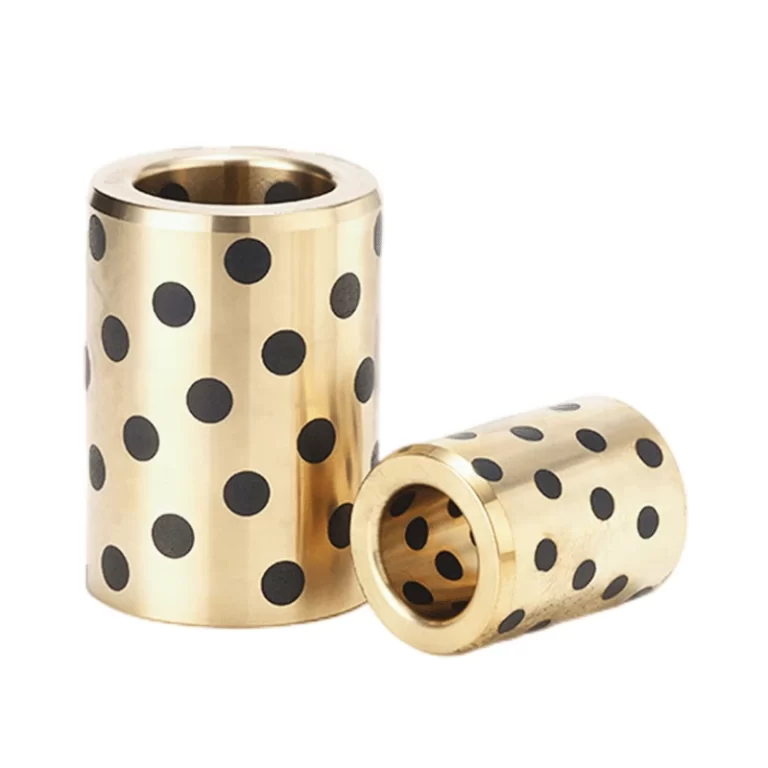
A graphite bronze bushing for a die set is a composite component. It uses a high-strength base—typically C86300 Manganese Bronze—which provides the structural rigidity to handle “pounding” and shock.
The inner diameter is patterned with holes filled with solid lubricant plugs (graphite mixed with specialized binders). As the die cycles, a microscopic layer of graphite is “smeared” onto the leader pin. This creates a low-friction boundary layer that is stable at high temperatures and doesn’t “run off” like oil.
Key Selection Factors for Progressive Die Components
Choosing the right bushing isn’t just about matching the catalog number; it’s about the physics of your specific stamping job.
1. PV Value (Pressure x Velocity)
In progressive dies, you have high pressure (from side-loading) and high velocity (from SPM).
- Manganese Bronze (C86300): Best for heavy-gauge stamping or high-impact forming. It has a high hardness (HB 210+) that resists “egging out.”
- Tin Bronze (C93200): Suitable for light-gauge, high-speed electronic terminals where loads are lower but cycle counts are in the millions.
2. Clearance and Thermal Expansion
Progressive dies generate heat. Bronze expands faster than the steel die set.
- Engineer’s Tip: If you are running at high speeds, you must specify a slightly larger clearance (f7 or g6 fit) to allow for “thermal growth.” If the fit is too tight at room temperature, the bushing will seize once the tool reaches its 60°C–80°C operating temperature.
3. Plug Pattern (The “Coverage” Factor)
For guide pillars, you want a staggered plug pattern. This ensures that every millimeter of the pin’s circumference is lubricated during the stroke. If the plugs are in a straight line, you’ll see “dry tracks” on the pins, which are the first places galling will occur.
Real Application Scenarios in the Press Room
1. High-Speed Connector Production
In the electronics industry, dies run at 400+ SPM. Using oilless bushings prevents oil mist from contaminating the delicate copper strips, which is critical if the parts are headed straight to a plating line. The graphite provides a clean, dry lubrication that doesn’t attract scrap “slugs” or dust.
2. Automotive Structural Components
When stamping thick-gauge high-strength steel (AHSS), the lateral forces on the guide pillars are immense. Standard bronze bushings would “smear” or deform. The high compressive strength of Manganese Bronze graphite bushings keeps the die perfectly aligned, extending the life of expensive carbide punches.
3. Draw and Form Stations
In stations where the metal is being “pulled,” the die remains closed for a fraction of a second longer, creating localized heat. Graphite bronze bushings used in the lifter and stripper plates ensure that these components retract smoothly without “hanging up.”
Common Problems and Failures
Even the best graphite bronze bushings will fail if the surrounding environment is neglected.
- Soft Leader Pins: This is a classic mistake. Graphite requires a hard mating surface to work. Your guide pillars must be induction-hardened to HRC 58-62. If you use soft pins, the bronze will actually act as an abrasive and eat the pin.
- Improper Press-Fit: If the housing hole in the die set is too small, you will crush the bushing during installation. This reduces the ID clearance and leads to immediate seizing. Always use a hydraulic press and check your bore tolerances (usually H7).
- Contamination: While these are “self-lubricating,” they aren’t “self-cleaning.” If metal slivers from the blanking stage get into the guide system, they get trapped in the graphite plugs and start scratching the pins. Ensure your die has proper scrap shedding and, if possible, felt wipers on the guide pillars.
Comparison: Ball Bearing Cages vs. Graphite Bronze
| Feature | Ball Bearing Cages | Graphite Bronze Bushings |
| Precision | Extremely High (Pre-loaded) | High (Running Clearance) |
| Speed | Excellent | Moderate to High |
| Load Capacity | Low (Point Contact) | High (Surface Contact) |
| Shock Resistance | Poor (Balls can dent races) | Excellent (Bronze absorbs shock) |
| Maintenance | Requires clean environment | Rugged / Self-Lubricating |
For high-precision, light-load work, ball cages are great. But for heavy-duty progressive dies where shock and lateral loads are present, the graphite bronze bushing is far more durable.
Why Maintenance Reduction is the Real ROI
The move toward self-lubricating bronze bearings in progressive dies is driven by the bottom line.
- Reduced Lubrication Labor: No more manual greasing every shift.
- Elimination of Oil Systems: You can remove complex, leaky auto-lube lines from the die set.
- Predictable Wear: Graphite bushings don’t fail “suddenly” like a seized steel joint. The wear is gradual, allowing you to plan maintenance during scheduled downtime rather than reacting to a broken tool.
Summary
In a progressive die, the guide system is the “insurance policy” for your punches and dies. Using graphite bronze bushings is the most effective way to stabilize that system.
- Match the alloy to your load (C86300 for heavy work).
- Harden your pins to HRC 60.
- Account for heat in your clearance specs.
By focusing on these mechanical fundamentals, you reduce guide system wear, eliminate “slug pulling” caused by misalignment, and ultimately keep the press running longer. In high-volume manufacturing, the most expensive part is a stopped machine; oilless technology is the simplest way to keep it moving.