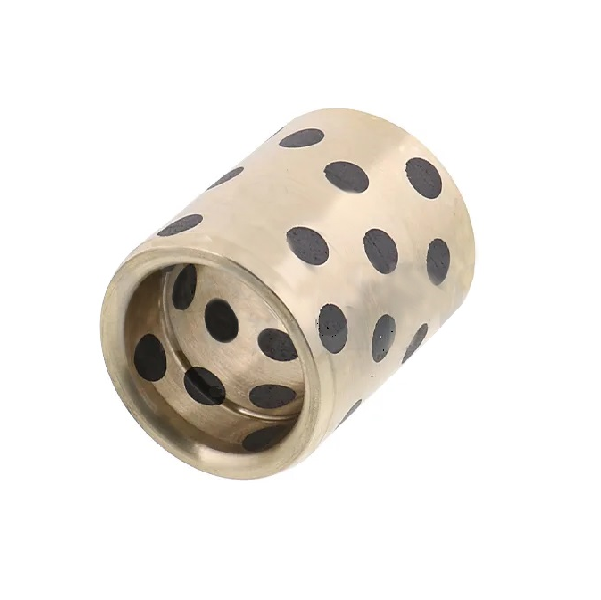
Getting the sizing wrong on a graphite bronze bushing is an expensive mistake. It’s not just about the numbers on a blueprint; it’s about understanding how those dimensions change once the part is pressed into a housing and subjected to thermal expansion. If you specify the wrong internal or external diameters, you’re looking at either a seized shaft or a bushing that spins freely in the bore—both of which lead to immediate machine downtime.
Understanding the Graphite Bronze Bushing Blueprint
A graphite bronze bushing (often referred to as a self-lubricating bronze bearing) is a composite solution. You have a high-strength bronze alloy base—typically C86300 Manganese Bronze or C95400 Aluminum Bronze—plugged with solid lubricant inserts.
Unlike standard oil-impregnated sintered bearings, these parts handle heavy loads at low speeds where a fluid film cannot be maintained. The “self-lubricating” aspect comes from the graphite plugs rubbing against the shaft, creating a thin film of dry lubricant. This makes the precise fit of the Internal Diameter (ID) and External Diameter (OD) critical, as there is no oil cushion to compensate for sloppy tolerances.
Defining the External Diameter (OD): The Press Fit Reality
The external diameter is determined by your housing bore. In 15 years of seeing these fail, the most common culprit is a “lazy” press fit.
Interference Fits and Housing Material
When you press a bronze bushing into a steel or cast-iron housing, the bushing OD must be slightly larger than the hole. For standard industrial applications, we typically look at an m6 or p6 tolerance for the bushing OD, paired with an H7 housing bore.
However, you have to account for the housing material:
- Steel/Cast Iron: Standard interference works well.
- Aluminum Housings: Aluminum has a much higher thermal expansion coefficient. If your machine runs hot, an aluminum housing will expand faster than the bronze, causing the bushing to lose its “grip” and start spinning. In these cases, you need a tighter interference fit or mechanical locking (like a flange or grub screw).
Wall Thickness vs. OD
Don’t spec a wall that is too thin. For a graphite bronze bushing, the wall thickness needs to be substantial enough to support the graphite plugs without cracking. A good rule of thumb is a wall thickness at least 10% to 15% of the ID. If the wall is too thin, the pressure from the interference fit can actually deform the bushing permanently or cause the graphite plugs to pop out.
Defining the Internal Diameter (ID): The “Close-In” Effect
This is where most junior engineers get tripped up. When you press an OD into a housing, the Internal Diameter will shrink. This is known as “close-in.”
Calculating the Finished ID
If you have a 50mm ID bushing and you press it into a housing with a 0.05mm interference, your ID will likely shrink by about 0.04mm to 0.05mm (depending on the wall thickness). If you haven’t accounted for this, your shaft won’t fit.
To get the required internal diameter, you must work backward:
- Desired Running Clearance: Usually 0.001 to 0.002 inches per inch of shaft diameter for industrial machinery.
- Add the “Close-In” factor: Calculate how much the ID will shrink based on the OD interference.
- Shaft Tolerance: Usually a g6 or h6 hardened shaft.
Thermal Expansion and ID
Graphite bronze bushings are often chosen for high-temperature environments (up to 300°C or even 400°C depending on the alloy). Bronze expands more than steel. If your shaft is steel and the bushing is bronze, the clearance will decrease as the temperature rises.
Pro Tip: If your operating temperature exceeds 150°C, you must increase the initial ID clearance. If you don’t, the bushing will “grow” onto the shaft and seize the moment the machine hits peak temperature.
Material Selection Based on Load and Speed
The ID and OD requirements are also dictated by the base metal. Not all “bronze” is the same.
| Material Grade | Common Name | Best For | Max Load (Static) |
| C86300 | Manganese Bronze | High load, low speed (Heavy Industry) | $100 \text{ N/mm}^2$ |
| C95400 | Aluminum Bronze | Wear resistance, corrosion (Marine/Washdown) | $70 \text{ N/mm}^2$ |
| C93200 | SAE 660 Tin Bronze | General purpose, lighter loads | $30 \text{ N/mm}^2$ |
If you are dealing with extreme loads, such as in mold components or hydraulic cylinder pivots, you need the Manganese Bronze base. The high hardness (HB 210+) ensures the OD doesn’t “creep” or deform under localized pressure.
Common Application Scenarios
1. Plastic Injection Molds
In mold bases, graphite bronze bushings are used for guide pillars. Here, accuracy is everything. The ID tolerance is usually kept very tight (H7) because any play in the bushing leads to flash on the molded part. Because molds cycle through temperature changes, the lubrication plugs are essential to prevent galling on the leader pins.
2. Automotive Assembly Lines
In robotic arms or heavy conveyors, these bushings handle “dirty” environments where grease would just attract grit and turn into sandpaper. Here, we spec larger clearances to allow small particles to be “swept” into the graphite grooves rather than getting trapped between the shaft and the ID.
3. Hydroelectric Gates
These are massive bushings with huge ODs. The challenge here is the “stick-slip” effect. Because the movement is so slow, the graphite must be high-quality to ensure the gate starts moving smoothly without jerking.
Common Mistakes to Avoid
- Ignoring Shaft Hardness: Never run a graphite bronze bushing on a soft cold-rolled steel shaft. The graphite needs a hard surface to burnish onto. Aim for a shaft hardness of at least HRC 45-50. If the shaft is too soft, the bronze will actually wear the shaft down.
- Over-Lubrication: It sounds counterintuitive, but adding heavy grease to a self-lubricating graphite bushing can sometimes hurt performance. The grease can prevent the graphite from transferring to the shaft, which is the very mechanism that makes these bushings work. If you must use grease, use a light lithium-based one, and never one with molybdenum disulfide (MoS2) as it can conflict with the graphite plugs.
- Rough Surface Finishes: If your housing bore is too rough (above 1.6 Ra), you won’t get a uniform press fit. This leads to “hot spots” on the ID because the bushing isn’t perfectly round once installed.
Comparison: Graphite Bronze vs. PTFE-Lined (DU) Bushings
A common question is: “Why not just use a thin-walled PTFE-lined bushing?”
- Graphite Bronze: Can be machined after installation. If your alignment is slightly off, you can re-ream the ID to corect it. They handle shock loads much better.
- PTFE-Lined: Cannot be machined. Once the 0.05mm PTFE layer is gone, the bushing is dead. They are great for high speed/low load, but they fail instantly in “dirty” or high-impact environments.
Summary of Selection Steps
When determining the internal and external diameters for your next project, follow this checklist:
- Confirm the Housing Bore: Measure the actual bore, don’t just trust the print.
- Calculate Interference: Aim for an m6 fit on the OD for standard steel housings.
- Account for Close-In: Assume the ID will shrink by 80%–100% of the interference amount.
- Factor in Heat: Add extra ID clearance if the operating temp is over 100°C.
- Check Shaft Hardness: Ensure your shaft is hardened and ground to an f7 or g6 tolerance.
If you focus on the relationship between the fit and the thermal environment, a graphite bronze bushing will easily outlast the machine it’s installed in. Getting the diameters right at the design stage is the difference between a “set and forget” component and a maintenance nightmare.
Do you have a specific load or temperature range for your current design? Getting those variables right is the next step in narrowing down the exact tolerance class.