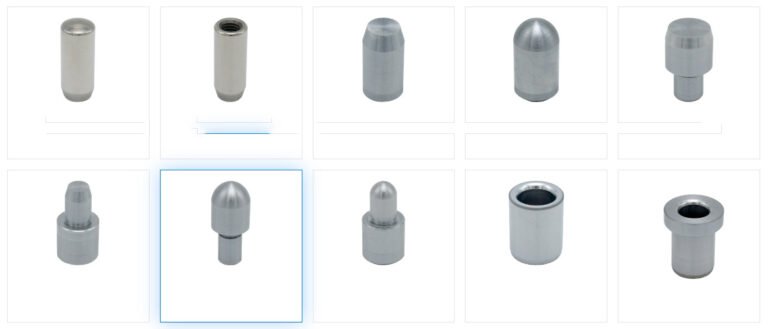
Dowel pins are precision-engineered cylindrical fasteners used to align or locate components in machinery, tools, jigs, fixtures, and assemblies. To ensure global compatibility and quality, dowel pins are manufactured according to recognized standards. Two of the most widely used are ISO (International Organization for Standardization) and ANSI (American National Standards Institute).
This guide explains the differences between ISO and ANSI dowel pin standards, covering dimensions, tolerances, materials, and applications.
1. Overview of the Two Standards
- ISO Standards:
Developed by the International Organization for Standardization, ISO dowel pin specifications are used globally, especially in Europe, Asia, and international manufacturing supply chains.- Common references: ISO 2338, ISO 8734, ISO 8735, ISO 8736.
- ANSI Standards:
Published by the American National Standards Institute, ANSI dowel pin specifications are primarily used in the United States and by companies supplying the US market.- Common references: ASME B18.8.2 (note: ASME writes the mechanical standard, ANSI adopts it).
2. Dimensional Differences
While both standards cover nominal diameters (e.g., 1 mm to 20 mm or 1/16″ to 1″), there are small but important differences:
- Metric vs Inch Units:
- ISO: Primarily metric sizes (e.g., Ø3 mm, Ø6 mm, Ø10 mm).
- ANSI: Primarily inch sizes (e.g., 1/8″, 1/4″, 3/8″).
- Length Increments:
- ISO: Lengths usually in whole millimeters.
- ANSI: Lengths in fractional inches.
- Tolerance Classes:
- ISO: Often uses m6 or h8 tolerance for diameter.
- ANSI: Uses “Standard” and “Oversized” series, with fixed decimal tolerances.
3. Tolerance and Fit
| Feature | ISO Standard | ANSI Standard |
|---|---|---|
| Diameter Tolerance | Typically m6 (press fit) or h8 (slip fit) | Standard: +0.0002″/−0.0000″ for nominal sizes |
| Length Tolerance | ±0.2 mm typical | ±0.010″ typical |
| Fit Types | Press-fit, slip-fit | Standard-fit, oversize-fit |
Key takeaway: ISO tolerances are expressed in ISO system of limits and fits, while ANSI tolerances are given in inch decimals.
4. Material and Hardness Requirements
Both ISO and ANSI standards specify similar materials but with different notations:
- ISO: Specifies materials like C45 (medium carbon steel), stainless steel grades (A1, A2, A4).
- ANSI: Uses US designations like AISI 1045, AISI 303, AISI 316.
Hardness:
- ISO hardened pins: typically 58–62 HRC.
- ANSI hardened pins: similar range, but often listed in Rockwell C directly without conversion.
5. Headed vs Headless Pins
- ISO: Covers both parallel dowel pins without head (ISO 2338, ISO 8734) and taper pins (ISO 8735).
- ANSI: Primarily covers straight dowel pins (headless), with taper pins covered in separate standards (ASME B18.8.2 Taper Pin section).
6. Interchangeability Issues
Mixing ISO and ANSI pins can cause assembly problems:
- Diameter mismatch: A 6 mm ISO pin will not match exactly with a 1/4″ hole.
- Tolerance differences: An ISO m6 pin may be too tight for an ANSI “standard fit” hole.
- Material callouts: Equivalent steel grades may vary slightly in composition and hardness.
7. Choosing the Right Standard
Consider:
- Market: Use ANSI for US-destined products, ISO for global supply chains.
- Machining Units: If your shop runs in metric, ISO will minimize conversion errors.
- Interchangeability: Keep all pins and mating holes within the same standard to avoid fit issues.
8. Reference Standards
- ISO 2338: Parallel pins, unhardened.
- ISO 8734: Parallel pins, hardened and ground.
- ISO 8735: Taper pins, unhardened.
- ASME B18.8.2: Taper pins and straight pins (ANSI adopted).